

Kitchen measurement and conversion isn’t just for fancy chefs. It’s what makes your chicken curry tender, your bakery cakes fluffy, and your smoothies perfectly balanced. When you skip proper measuring cups and spoons, you risk recipe failure soggy bread, bitter sauce, or soup that tastes like water.
I’m Chef Asif, and after 8+ years in professional kitchens and home cooking education, I can tell you this with absolute certainty: precision in measurement is the foundation of every great dish, whether you’re seasoning a soup, baking bread, or reducing a sauce.
A small difference between a pinch of salt and a quarter teaspoon can transform a beautiful dish into an inedible one.
This guide helps you everything you need to measure, convert, and scale recipes accurately, from the smallest teaspoon to bulk batch cooking. Whether you follow American cups, British weights, or Australian measurements, you’ll find the conversion you need here.
The Two Main Systems: Metric vs Imperial
Metric System Cooking (Used Globally & in Pakistan):
- Units: grams (g), milliliters (mL), liters (L)
- Pros: Precise, easy to scale, standard in science
- Common in: Europe, Asia, Australia, and modern Pakistani recipes
Imperial System Baking (US/UK Traditional):
- Units: cups, tablespoons (tbsp), teaspoons (tsp), ounces (oz), pounds (lb)
- Pros: Familiar to old-school cooks
- Common in: US, UK, older Western recipes
How Kitchen Measurements Actually Work
Kitchen measurements operate on two fundamental principles, and understanding the difference between them transforms your cooking:
Volume measures space: how much room an ingredient takes up in your measuring cup or bowl. Volume measurements are fixed:
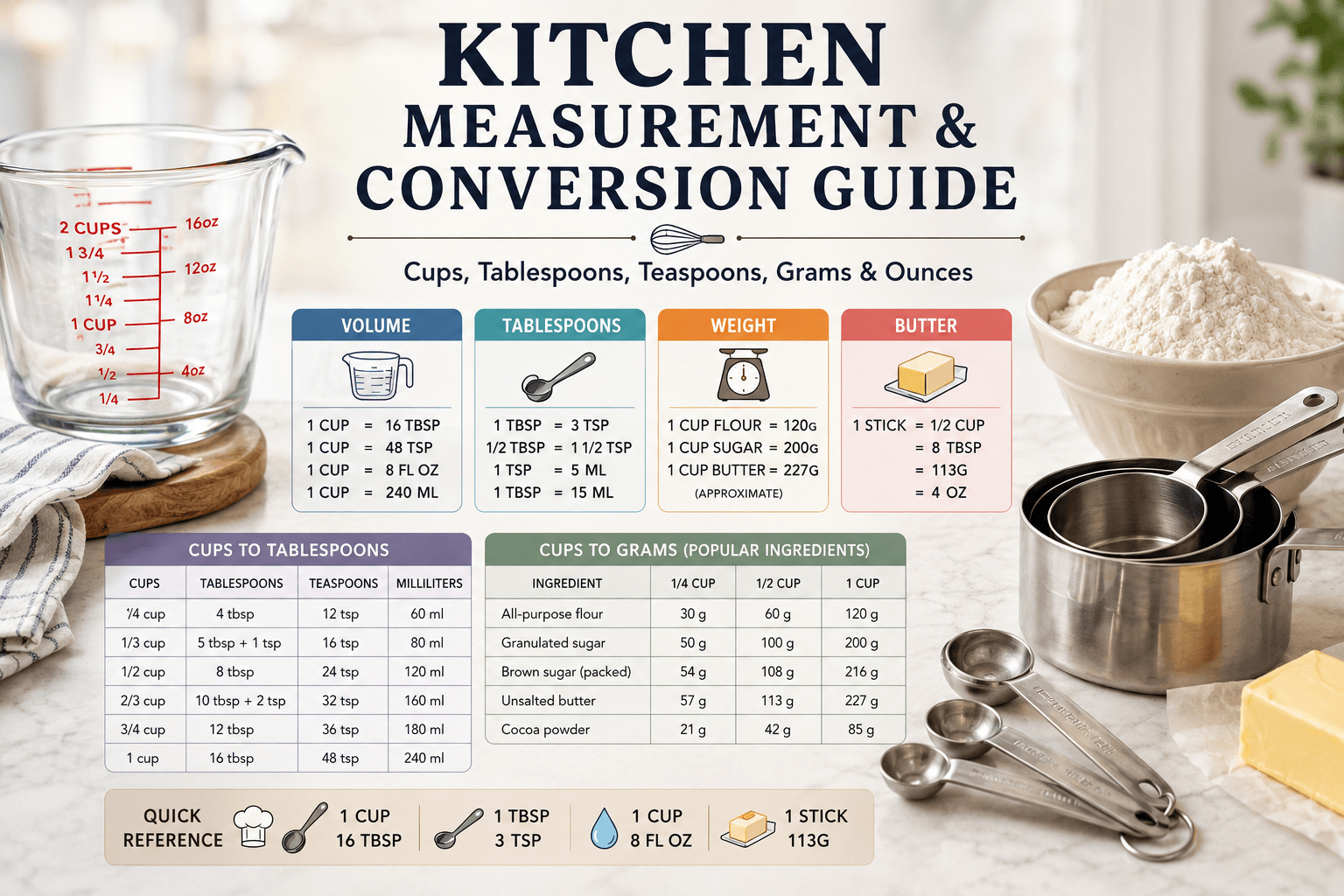
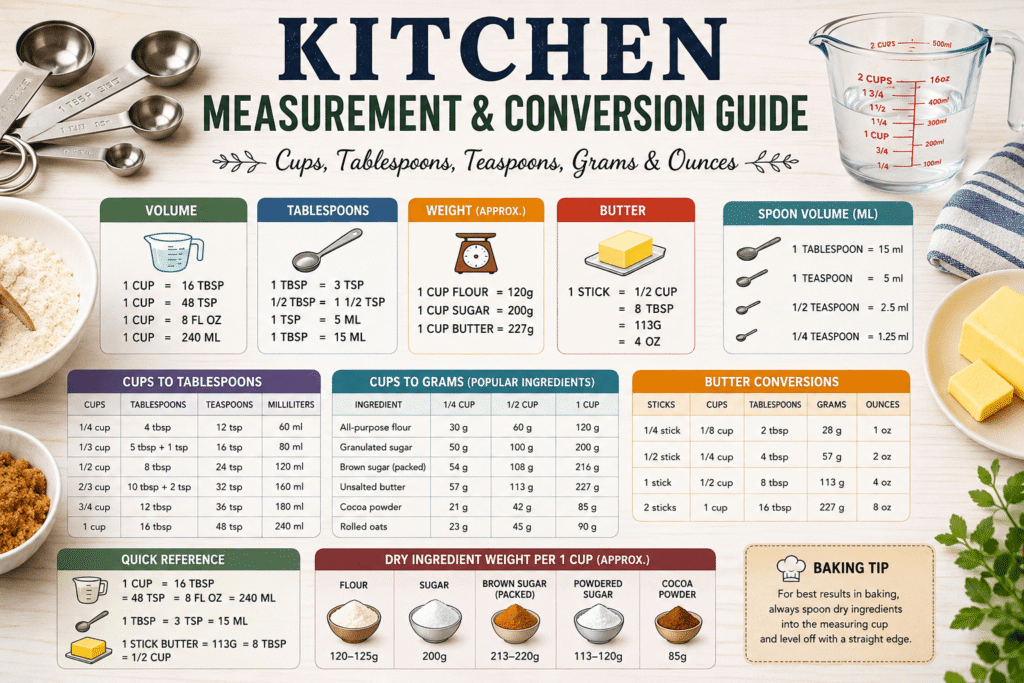
- 1 US cup = 16 tablespoons (always)
- 1 US cup = 48 teaspoons (always)
- 1 US cup = 240 milliliters (always)
Weight measures mass—how heavy an ingredient actually is. This is where confusion starts, because:
- 1 cup of flour ≠ 1 cup of sugar (by weight)
- 1 cup of butter ≠ 1 cup of honey (by weight)
- The same cup, filled with different ingredients, produces wildly different weights
Why This Matters in Your Kitchen
Imagine you’re making two different dishes:
- A savory pan sauce (volume-forgiving): More or less liquid won’t ruin it; reduction adjusts the final taste
- A cake batter (weight-sensitive): 20 grams too much flour and your cake becomes dense; too little and it collapses
This is why professional kitchens use scales. Home cooks should too—especially for baking, sauces, and spice ratios.
Volume Conversions: The Foundation of Kitchen Math
Memorize this one fact: 1 cup = 16 tablespoons. Everything else flows from this.
| Cups | Tablespoons | Teaspoons | Milliliters |
| 1/16 cup | 1 tbsp | 3 tsp | 15 ml |
| 1/8 cup | 2 tbsp | 6 tsp | 30 ml |
| 1/4 cup | 4 tbsp | 12 tsp | 60 ml |
| 1/3 cup | 5 tbsp + 1 tsp | 16 tsp | 80 ml |
| 1/2 cup | 8 tbsp | 24 tsp | 120 ml |
| 2/3 cup | 10 tbsp + 2 tsp | 32 tsp | 160 ml |
| 3/4 cup | 12 tbsp | 36 tsp | 180 ml |
| 1 cup | 16 tbsp | 48 tsp | 240 ml |
| 2 cups | 32 tbsp | 96 tsp | 480 ml |
| 4 cups (1 quart) | 64 tbsp | 192 tsp | 960 ml |
Practical Application from My Kitchen: When a recipe calls for 3/4 cup and you only have tablespoons, don’t panic that’s 12 tablespoons. When you’re missing your 1/3 cup measure (the least common size), fill your 1/4 cup once, then add 2 tablespoons and 2 teaspoons. Done.
Tablespoons to Teaspoons: The Small Stuff That Matters Most
One tablespoon = exactly three teaspoons. Period.
This matters most when measuring:
- Baking powder and baking soda (too much = bitter taste; too little = dense batter)
- Salt in doughs and marinades
- Vanilla extract and other flavorings
- Ground spices (cumin, coriander, cardamom)
| Tablespoons | Teaspoons | Milliliters |
| 1/4 tbsp | 3/4 tsp | 1.25 ml |
| 1/2 tbsp | 1.5 tsp | 2.5 ml |
| 1 tbsp | 3 tsp | 15 ml |
| 2 tbsp | 6 tsp | 30 ml |
| 3 tbsp | 9 tsp | 45 ml |
| 4 tbsp (1/4 cup) | 12 tsp | 60 ml |
| 8 tbsp (1/2 cup) | 24 tsp | 120 ml |
When measuring baking powder or salt, always level off with a straight edge, a heaping teaspoon can be 50% more than a level teaspoon. This precision matters.
Cups to Fluid Ounces: Liquids Only
This is a clean conversion because all liquids have roughly the same density.
Rule: 1 US cup = 8 fluid ounces (always)
| Cups | Fluid Ounces | Milliliters |
| 1/4 cup | 2 fl oz | 60 ml |
| 1/3 cup | 2.67 fl oz | 80 ml |
| 1/2 cup | 4 fl oz | 120 ml |
| 3/4 cup | 6 fl oz | 180 ml |
| 1 cup | 8 fl oz | 240 ml |
| 2 cups | 16 fl oz | 480 ml |
| 4 cups | 32 fl oz | 960 ml |
What Counts as Liquid:
- Water, milk, cream, buttermilk
- Oil, melted butter, ghee
- Stock, broth, soy sauce
- Eggs (approximately 1 large egg = 2 fl oz)
- Honey, maple syrup, molasses (by volume, not weight)
Cups to Ounces (Weight): Where It Gets Tricky
This is where many home cooks get confused. The conversion between cups and ounces is NOT fixed for dry ingredients, it depends entirely on ingredient density.
For Liquids: Simple Rule
1 cup liquid = 8 fluid ounces (always)
For Dry Ingredients: Density Is Everything
| Ingredient | Ounces per Cup | Grams per Cup | Why the Difference |
| All-purpose flour | 4.2–4.5 oz | 120–128 g | Depends on how tightly packed |
| Bread flour | 4.8 oz | 136 g | Denser flour = heavier |
| Cake flour | 3.9 oz | 110 g | Lighter, finer grind |
| Granulated sugar | 7.05 oz | 200 g | Dense, no air pockets |
| Brown sugar (packed) | 7.5 oz | 213 g | Compacted; loose = much lighter |
| Powdered sugar | 4.2 oz | 120 g | Airy, lots of trapped air |
| Cocoa powder | 3 oz | 85 g | Very light and fluffy |
| Rolled oats | 3.2 oz | 90 g | Large particles, lots of air |
| Butter | 8 oz | 227 g | Much denser than flour |
| Honey | 11 oz | 340 g | Very dense; measured by volume but weighs a lot |
I measure flour by weight in my kitchen because scooping directly into a measuring cup can add 20–30 grams (almost 50% more) compared to the spoon-and-level method. For consistency, I use a kitchen scale, it eliminates this variable entirely.
Cups to Grams: The Professional Standard
Converting to grams is the most important skill for anyone serious about cooking and baking. Why? Because grams are objective; cups are subjective.
Common Kitchen Ingredients: Cups to Grams
| Ingredient | 1/4 Cup | 1/3 Cup | 1/2 Cup | 1 Cup |
| All-purpose flour | 30 g | 40 g | 60 g | 120 g |
| Bread flour | 34 g | 45 g | 68 g | 136 g |
| Cake flour | 27 g | 37 g | 55 g | 110 g |
| Granulated sugar | 50 g | 67 g | 100 g | 200 g |
| Brown sugar (packed) | 54 g | 72 g | 108 g | 216 g |
| Powdered sugar | 30 g | 40 g | 60 g | 120 g |
| Unsalted butter | 57 g | 76 g | 113 g | 227 g |
| Cocoa powder | 21 g | 28 g | 42 g | 85 g |
| Honey | 85 g | 113 g | 170 g | 340 g |
| Rolled oats | 23 g | 30 g | 45 g | 90 g |
| Almond flour | 24 g | 32 g | 48 g | 96 g |
| Cornstarch | 30 g | 40 g | 60 g | 120 g |
| Kosher salt | 18 g | 24 g | 36 g | 72 g |
| Baking powder | 5 g | 7 g | 10 g | 20 g |
| Baking soda | 4 g | 6 g | 9 g | 18 g |
Why the Same Cup Gives Different Weights
- Density: Honey is thick; powdered sugar is airy. Same volume, very different weight.
- Packing method: Brown sugar packed tightly = heavier; brown sugar loosely measured = much lighter.
- Technique: Spooning flour gently gives ~120 g per cup; scooping directly gives ~150 g per cup.
- Sifting: Sifted flour weighs about 15% less than unsifted flour of the same volume.
- Humidity: Flour absorbs moisture from the air, changing its density slightly over time.
Scaling Recipes Up and Down: The Math You Need
Doubling a Recipe
Multiply all measurements by 2:
- 1 teaspoon → 2 teaspoons
- 1 tablespoon → 2 tablespoons
- 1/2 cup → 1 cup
- 2 cups → 4 cups
Exception: Salt, spices, and leavening agents often don’t scale linearly. A recipe that serves 4 might need only 1.5× the salt when doubled; taste and adjust.
Halving a Recipe
Divide all measurements by 2:
- 1 teaspoon → 1/2 teaspoon
- 1 tablespoon → 1.5 teaspoons
- 1/2 cup → 1/4 cup
- 2 cups → 1 cup
For odd amounts, convert to the next smaller unit. For example:
- 3 tablespoons ÷ 2 = 1.5 tablespoons = 1 tablespoon + 1.5 teaspoons
Tripling or Quadrupling
Use the same multiplication:
- Tripling: Multiply by 3
- Quadrupling: Multiply by 4
Butter Conversions: American, British, Australian
Butter measurements vary wildly depending on your recipe source:
- American recipes: Sticks and cups
- British recipes: Grams and ounces
- Australian recipes: Grams; also use 20 ml tablespoons
The Foundation: 1 American stick = 1/2 cup = 8 tablespoons = 113–115 grams = 4 ounces
Here is Complete Butter Conversion Chart
| Sticks | Cups | Tablespoons | Grams | Ounces |
| 1/4 stick | 1/8 cup | 2 tbsp | 28–29 g | 1 oz |
| 1/2 stick | 1/4 cup | 4 tbsp | 57 g | 2 oz |
| 1 stick | 1/2 cup | 8 tbsp | 113–115 g | 4 oz |
| 1.5 sticks | 3/4 cup | 12 tbsp | 170 g | 6 oz |
| 2 sticks | 1 cup | 16 tbsp | 227–230 g | 8 oz |
| 3 sticks | 1.5 cups | 24 tbsp | 340 g | 12 oz |
| 4 sticks | 2 cups | 32 tbsp | 454 g | 16 oz (1 lb) |
Butter by the Tablespoon and Teaspoon
| Amount | Grams | Ounces |
| 1 teaspoon | 4.7 g | 0.17 oz |
| 1 tablespoon | 14.2 g | 0.5 oz |
| 2 tablespoons | 28.4 g | 1 oz |
| 4 tablespoons | 56.7 g | 2 oz |
| 8 tablespoons | 113 g | 4 oz |
| 16 tablespoons | 227 g | 8 oz |
Flour Conversions: Ingredient Specific Weights
Flour is temperamental. Different flour types weigh differently; the same flour packed different ways weighs differently.
All-Purpose Flour: Full Breakdown
| Amount | Grams (Spoon & Level) | Ounces |
| 1 tbsp | 8 g | 0.28 oz |
| 2 tbsp | 15 g | 0.53 oz |
| 1/8 cup | 15 g | 0.53 oz |
| 1/4 cup | 30 g | 1.06 oz |
| 1/3 cup | 40 g | 1.41 oz |
| 1/2 cup | 60 g | 2.12 oz |
| 2/3 cup | 80 g | 2.82 oz |
| 3/4 cup | 90 g | 3.17 oz |
| 1 cup | 120–125 g | 4.2–4.4 oz |
| 2 cups | 240–250 g | 8.5–8.8 oz |
Flour Type Comparison: Weight per Cup
| Flour Type | Grams per Cup | Best Used For |
| All-purpose flour | 120–125 g | Bread, cakes, cookies, pancakes, pastry |
| Bread flour | 130–136 g | Yeast breads, pizza dough, bagels |
| Cake flour | 100–110 g | Sponge cakes, layer cakes, cupcakes |
| Whole wheat flour | 128–130 g | Hearty loaves, muffins, dense bakes |
| Self-raising flour | 120–125 g | Scones, quick breads (contains leavening) |
| Almond flour | 96–100 g | Gluten-free baking, macarons, frangipane |
| Rice flour | 158–162 g | Gluten-free cakes, tempura batter, coatings |
| Cornstarch | 120 g | Sauce thickening, shortbread, coatings |
Sugar Conversions of All Types
Sugar is more forgiving than flour when measured by volume, but weights still vary by type.
Granulated White Sugar
| Amount | Grams | Ounces |
| 1 teaspoon | 4 g | 0.14 oz |
| 1 tablespoon | 12–13 g | 0.44 oz |
| 1/4 cup | 50 g | 1.76 oz |
| 1/3 cup | 67 g | 2.36 oz |
| 1/2 cup | 100 g | 3.53 oz |
| 2/3 cup | 133 g | 4.70 oz |
| 3/4 cup | 150 g | 5.29 oz |
| 1 cup | 200 g | 7.05 oz |
Brown Sugar (Firmly Packed)
| Amount | Grams | Ounces |
| 1 tablespoon | 13.5–14 g | 0.48 oz |
| 1/4 cup | 54 g | 1.90 oz |
| 1/3 cup | 72 g | 2.54 oz |
| 1/2 cup | 108 g | 3.81 oz |
| 3/4 cup | 162 g | 5.71 oz |
| 1 cup | 213–220 g | 7.5–7.76 oz |
Important: Brown sugar must be packed for these measurements. Loosely measured brown sugar can be 40 grams lighter per cup.
Powdered/Icing/Confectioners’ Sugar
| Amount | Grams | Ounces |
| 1 tablespoon | 7–8 g | 0.25–0.28 oz |
| 1/4 cup | 30 g | 1.06 oz |
| 1/2 cup | 60 g | 2.12 oz |
| 1 cup | 113–120 g | 4–4.2 oz |
Powdered sugar is airy and absorbs moisture easily, so measurements can vary. Sifting it before measuring reduces the weight per cup by about 15%.
Salt Conversions that Often Overlooked, Always Critical
Salt density varies dramatically based on type. Table salt is finer and denser than kosher salt; sea salt depends on crystal size.
Salt by Type: Grams per Tablespoon
| Salt Type | Grams per Tbsp | Notes |
| Table salt | 18 g | Fine crystals; very dense |
| Diamond Crystal kosher salt | 10 g | Large, hollow crystals; very light |
| Morton kosher salt | 14 g | Denser than Diamond Crystal |
| Sea salt (fine) | 17 g | Similar to table salt |
| Sea salt (coarse) | 12–14 g | Depends on crystal size |
I use weight for salt in doughs and marinades because 1 tablespoon can vary from 10 to 18 grams depending on the salt type. For everyday cooking (seasoning to taste), volume is fine. For precision recipes bread, cured fish, stocks, use a scale.
Spice and Seasoning Conversions
Spices are potent and density-dependent. Always measure carefully.
Here’s Common Spices and Seasonings: Grams per Tablespoon
| Spice/Seasoning | Grams per Tbsp | Critical Use |
| Baking powder | 15 g | Leavening agent; too much = bitter |
| Baking soda | 12 g | Leavening agent; too much = metallic taste |
| Ground cinnamon | 7 g | Desserts, spiced dishes |
| Ground cumin | 8 g | Savory dishes, curries |
| Ground coriander | 6 g | Curries, pickling |
| Paprika (sweet) | 7 g | Color and mild flavor |
| Chili powder | 7 g | Heat and depth |
| Garlic powder | 9 g | Convenience seasoning |
| Onion powder | 8 g | Savory dishes |
| Ground ginger | 6 g | Desserts, Asian cooking |
When measuring spices, always level off with a straight edge heaping vs. level makes a huge difference with potent seasonings.
Measuring Systems Around the World
The world doesn’t use American cups. Understanding regional differences prevents recipe failure.
| System | 1 Cup | 1 Tablespoon | Used In |
| US Standard | 240 ml | 15 ml | American recipes, most online blogs |
| UK Imperial | 284 ml | 15 ml | Old British cookbooks (mostly discontinued) |
| Australian Metric | 250 ml | 20 ml | Australian recipes and cookbooks |
| Metric (Global) | — | — | Weights in grams/ml; most accurate internationally |
Critical Difference: Australian tablespoons are 20 ml, not 15 ml. If you’re following an Australian recipe with US measuring spoons:
- Add an extra teaspoon per tablespoon called for, OR
- Convert everything to grams and use a scale
Here is The Master Conversion Table
One table covering every essential ingredient in common measurements:
| Ingredient | 1 Tbsp (g) | 1/4 Cup (g) | 1/2 Cup (g) | 1 Cup (g) |
| All-purpose flour | 8 | 30 | 60 | 120 |
| Bread flour | 9 | 34 | 68 | 136 |
| Cake flour | 7 | 27 | 55 | 110 |
| Granulated sugar | 12.5 | 50 | 100 | 200 |
| Brown sugar (packed) | 14 | 54 | 108 | 216 |
| Powdered sugar | 8 | 30 | 60 | 120 |
| Unsalted butter | 14 | 57 | 113 | 227 |
| Cocoa powder | 6 | 21 | 42 | 85 |
| Honey | 21 | 85 | 170 | 340 |
| Rolled oats | 6 | 23 | 45 | 90 |
| Almond flour | 6 | 24 | 48 | 96 |
| Cornstarch | 8 | 30 | 60 | 120 |
| Kosher salt | 9 | 36 | 72 | 144 |
| Baking powder | 5 | 20 | 40 | 80 |
| Baking soda | 4 | 18 | 36 | 72 |
| Ground cinnamon | 3 | 7 | 14 | 28 |
| Ground ginger | 2.5 | 6 | 12 | 24 |
Frequently Asked Questions
How many tablespoons are in a cup?
Exactly 16 tablespoons = 1 US cup. Half a cup is 8 tablespoons; a quarter cup is 4 tablespoons. This is the single most useful kitchen conversion to memorize.
How many teaspoons are in a tablespoon?
3 teaspoons = 1 tablespoon. This holds true across US, UK, and most other measuring spoon standards.
Is 1 cup always 8 ounces?
Only for liquids. 1 cup of liquid = 8 fluid ounces (always). For dry ingredients, the weight varies by density. All-purpose flour weighs about 4.2–4.5 oz per cup; granulated sugar weighs about 7 oz per cup. When in doubt, use weight (grams) instead of volume.
How many grams is 1 cup of all-purpose flour?
Answer: 120–125 grams when measured using the spoon-and-level method. Scooping directly can give you 140–160 grams, which noticeably affects baking results.
How do I convert cups of sugar to grams?
- Granulated white sugar: 1 cup = 200 grams
- Brown sugar (packed): 1 cup = 213–220 grams
- Powdered sugar: 1 cup = 113–120 grams
Density and air pockets cause the difference.
How much does 1 stick of butter weigh?
113–115 grams (4 ounces), or 1/2 cup, or 8 tablespoons. Two sticks make 1 cup (227 g).
What’s the difference between fluid ounces and weight ounces?
- Fluid ounces measure volume (space a liquid occupies)
- Weight ounces measure mass (how heavy something is)
For water, these are nearly equal. For other substances, they diverge. When a recipe says “4 oz of cream,” it usually means weight. When it says “4 fl oz of milk,” it means volume.
Is an Australian tablespoon the same as a US tablespoon?
No. A US tablespoon is 15 ml. An Australian tablespoon is 20 ml. This 5 ml difference is significant for spices, salt, and leavening agents. When following Australian recipes with US equipment, add one extra teaspoon per tablespoon.
Can I use the same measuring cup for liquids and dry ingredients?
Technically yes, but it’s not ideal. Liquid measuring cups have a spout and side markings, letting you read the level without overfilling. Dry measuring cups are filled level and swept clean. Using the wrong type introduces small inaccuracies, particularly in baking.
Why does the same cup give different gram weights in different recipes?
Because technique matters. A cup of flour spooned gently weighs ~120 g; a cup scooped directly may weigh 150 g. Recipe developers also use different baseline weights. Weighing on a kitchen scale eliminates this ambiguity entirely.
Final Thoughts from Chef Asif
The best kitchen tool is not a stand mixer or a Japanese knife. It’s understanding. When you know that one tablespoon of butter weighs about 14 grams, or that your cup of powdered sugar is 80 grams lighter than your cup of granulated sugar, you stop following recipes blindly and begin cooking with intelligence.
Kitchen measurements are the invisible foundation of every great dish. Master them, and you master cooking itself.
