

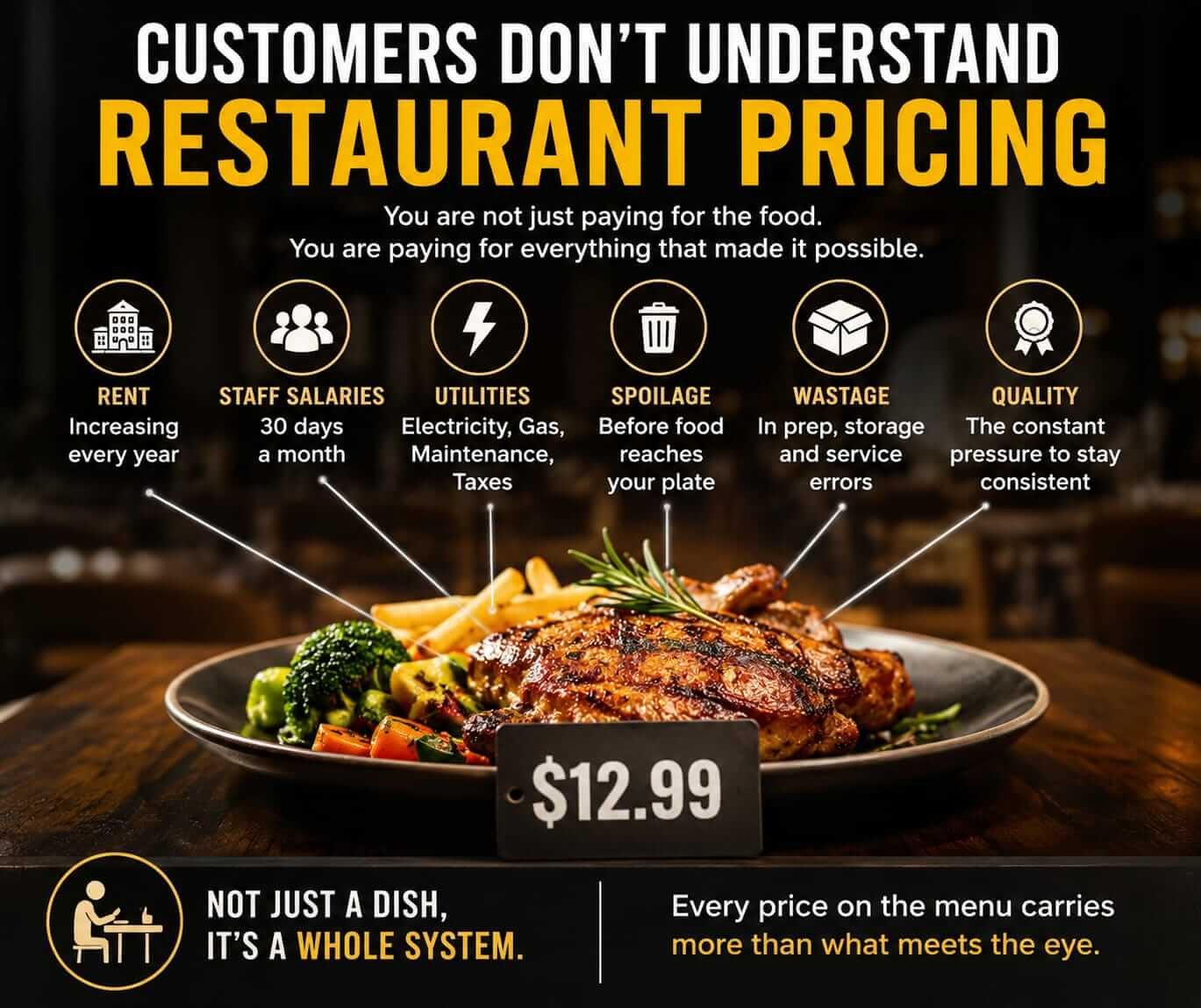
Restaurant food is expensive in 2026 because of rising rent, labor costs, ingredient inflation, and operational waste not because of high profit margins.
I have been in professional kitchens for a long time. And the one question that follows me everywhere is not about cooking techniques. It is not about recipes either.
A few nights ago, after dinner service, I sat in the kitchen office reading comments on a post we shared on the Bunchway LinkedIn page.
The post was simple. Why restaurant food prices feel so high now. I thought a few chefs might react to it.
Instead, restaurant owners, food service managers, suppliers, and customers all joined the discussion. Some agreed.
- Some pushed back.
- Some shared numbers from their own kitchens.
Honestly, I liked that.
I have had this one conversation more times than I can count. A customer leans over the counter and says, “Chef, why is restaurant food so expensive?”, “Chef, why does this cost so much? I can make it at home for less.”
Read Also: The Complete Guide to Pakistani Home Cooking
And I always smile. Because I understand why they feel that way. The questions I hear from guests When someone sits at a table, I can almost guess what they are thinking.
“Why is this dish priced like this”
“Do restaurants earn too much money”
“ Why do prices keep going up”
“What makes food costing so complex”
I hear it from friends. I even heard it from my own family the first time they visited a restaurant I was working in.
Why Customers Think Restaurant Food Is Expensive
The moment we enter a restaurant and open the menu, questions immediately come to mind:
- “Why is restaurant food expensive?”
- “Do restaurants make high profits?”
- “What affects restaurant pricing?”
- “Why are menu prices increasing?”
- “How do restaurants calculate food costs?”
- “What is the average restaurant profit margin?”
When we look at a menu, we see: “Why is this dish expensive?”
What the Menu Does Not Show You
A menu shows you two things.
- The dish.
- The final price.
That is it.
- It does not show you the 10am prep that started before any customer arrived.
- It does not show you the delivery that came in yesterday, the one the chef carefully checked and stored.
- It does not show you the staff meeting before service, or the deep clean that happened after the last table left.
- It does not show you Stock simmering. Vegetables getting chopped. Chicken getting marinated.
- “Rent that keeps increasing every year”
- “Staff salaries that run 30 days a month”
- Electricity, gas, maintenance, taxes
- Wastage in prep, storage, and service errors
What you see on a menu is the final number after all of that. And behind that number is a long list of costs that never stop.
First, Let Me Tell You Something About Cooking at Home
One of the comments I read recently stopped me in my tracks.
A man named Michael Halker, Director of Food Service Sales- Central Region wrote something very honest.
“What is crazy, is that if you went out to buy all the individual ingredients to make this exact dish at home, you will spend far more money on all those ingredients then the cost of paying the restaurant to do it for you. At home, you will buy a package of chicken, but only use a couple of chicken breasts, so hopefully you keep the remaining chicken for another day to keep your at home cost per meal down. You will buy a whole box of pasta to make enough for just the side dish, you will buy a package of rosemary, and only use a couple of sprigs, etc. Unless you manage your home like a restaurant manufacturing kitchen, it no longer is cheaper to grocery shop and cook for yourself!! This dish above at only $12.99 is a bargain!! 🙂 “
Michael Halker
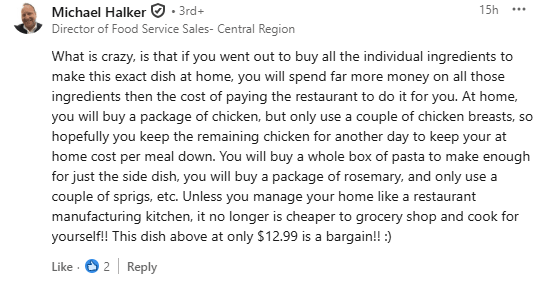
He is right. And most people do not realise this.
What Most People Never Notice About Ingredients
Let me give you a simple kitchen example.
A customer orders creamy garlic chicken pasta.
Looks simple on the plate.
But behind that dish is:
- cream
- butter
- garlic
- parmesan
- herbs
- pasta
- chicken stock
- oil
- seasoning
- garnish
Now imagine one table ordering it.
The kitchen still had to prepare enough ingredients for many possible orders during service.
- That means more prep.
- More storage.
- More cooling space.
- More waste risk.
One rainy evening can completely change the numbers.
If you are Pakistani or Indian food lovers then think about it simply.
- You want to make one chicken karahi at home.
- You go to the market. You buy a full chicken.
- You buy a box of tomatoes.
- You buy a bunch of green chillies, a packet of ginger, a packet of garlic, a bottle of oil, and whole spices.
- You use what you need. The rest sits in your fridge.
- You did not cook for one. You shopped for one but bought for ten.
A restaurant does the same shopping. But it spreads those costs across many plates. That is the only reason the per plate cost can sometimes feel lower than home cooking.
This is something I learned in my first year of running a kitchen. The math of cooking for one is completely different from cooking for many.
But Here Is What Still Makes It Hard
Even with all those ingredients shared across many plates, the numbers are still very tight.
Let me walk you through my own kitchen. Every morning I wake up before most people are out of bed.
- I check what came in from the supplier.
- I check what needs to be used today before it turns.
- I check what I ordered and what actually arrived.
That process alone tells you something. Managing a kitchen is not just cooking. It is a daily fight against waste, against spoilage, against small losses that add up to big ones.
Hidden Costs Behind Every Plate | The Real Costs Behind Every That Never Stop
Rent Comes Every Month Without Fail
My rent is fixed. It arrives at the start of every month like a guest who never checks if you are busy.
It does not matter if last week was quiet and if the rain kept customers away for three days. The number is the same.
In 2026, rents for commercial spaces have gone up in almost every city. A kitchen space that was manageable a few years ago now takes a much bigger bite out of monthly revenue.
That cost has to go somewhere. It goes into every plate. There is no other way to cover it.
People Work Here Every Day
I have a small team. But even a small team costs money every month.
My cook has been with me for six years. My helper has been here for five. They have families. They have bills.
I pay them whether it is a full day or a half day. Whether we had a wedding order that kept us busy for two days straight or a Tuesday where three tables came in.
Labour is usually the biggest cost in any food business. Most kitchens spend between 30 and 35 percent of their total revenue just on staff.
When someone pays for a plate of food, part of that money keeps my cook’s daughter in school. I think about that sometimes.
Utilities Run All Day
People think restaurants only cost money during busy hours. My refrigerator never switches off.
My gas runs from early in the morning. Along this, My water usage is high because a clean kitchen is not optional. Electricity for lights, exhaust fans, the deep freezer.
These bills come every month. And they are not small. Even before the first customer arrives, money is already being spent. That part is invisible to guests.
Most people who have never run a commercial kitchen do not know what an electricity bill looks like for one. I do. It is one of those numbers that surprises you the first time you see it.
According to Jay Douglas (Inventor and Managing Partner of Gaming Media Services, LLC )
“I think most people with any sophistication at all understand that it isn’t just the cost of the food on your plate that determines the price being charged. But if you made a bad deal on your rent, have excessive waste, aren’t spending your marketing dollars wisely, etc…that doesn’t give you the right to gouge the customer. “
Jay Douglas
And honestly, I agree with him. A restaurant cannot hide bad operations behind high menu prices forever.
I have seen kitchens fail because owners stopped controlling costs properly.
- Too much wastage.
- Huge menus nobody could manage.
- Buying expensive ingredients that customers never ordered.
- That destroys restaurants quietly.
Spoilage Is the Cost That Hurts Most
This one is personal. I hate wasting food. I genuinely hate it.
Fresh ingredients have short lives.
- Fish moves fast.
- Herbs wilt quickly.
- Dairy has a small window.
- Fresh naan dough changes with weather.
Customers rarely think about spoilage because they only see fresh food arriving at the table.
People underestimate kitchen waste.
- A spoon of sauce here.
- Half a tomato there.
- Burned bread during rush hour.
- Extra fries thrown away at closing.
It looks tiny in the moment. Now multiply that by 200 plates a day. Then multiply it across a month. Now the numbers start hurting. Good kitchens survive because they respect small costs.
I have become better at this over the years. Managing yield, rotating stock, planning menus around what needs to move. But it never becomes zero.
The Supplier Calls Nobody Sees
Customers see the finished plate. They never see the stressful phone calls before lunch service.
- “Chef, chicken price went up again.”
- “Chef, tomatoes are delayed.”
- “Chef, your seafood delivery is smaller today.”
This happens constantly. Some mornings you stand there holding a menu priced three months ago while ingredient costs have already changed twice. That pressure is real.
What Customers Think Profit Looks Like
A lot of people believe restaurants make huge money from every dish.
I wish that were true. Most restaurants operate on thin margins. Very thin.
- One broken freezer can ruin a week.
- One slow month can damage cash flow badly.
- One rent increase can force menu changes overnight.
This business looks glamorous from outside. Inside the kitchen, it is constant balancing.
Real Restaurant Cost Breakdown (COGS Explained)
The Magic Number Every Restaurant Owner Knows. According to food and beverage consultant Michael Tuohy (Principal, Fullhouse Hospitality, Food & Beverage Advisory) . He mentioned
“Right thought process overall, doesn’t tell the whole story. Cost of goods (COGS) represents a significant piece of the pie or, sales dollar(s). Every operation has a “Magic Number”, which is the % of sales that prime costs (COGS+Labor) CANNOT exceed ex. 65% of sales at most on average across the industry. If the prime costs exceed it, there is no room left for profit. Simple restaurant 101. Every operation has it’s nuances but, that is a pretty good benchmark. In most restaurants and food service operations, there are TWO categories to make sales, Food & Beverage. Yet, there are potentially 48 line items to LOSE money. The economics couldn’t be more challenging! All while trying to provide exceptional quality and value to retain and attract new customers in a highly competitive market place. The industry is in unprecedented times with more headwinds and cost pressures than prior years. However, the same economics apply as they always have. “
Michael Tuohy
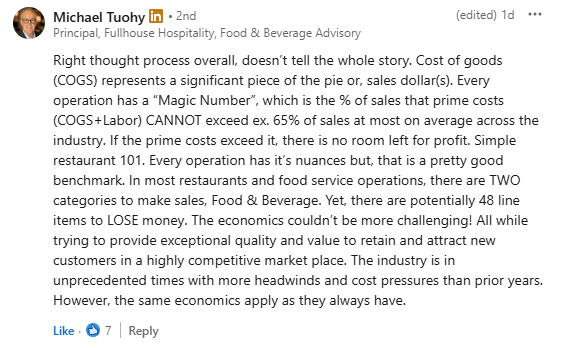
He is absolutely right. And I want to explain this simply because it matters.
In any restaurant, there are two main costs. The cost of ingredients (we call it COGS, cost of goods sold) and the cost of labour.
Add those two together and you get your prime cost.
The rule that most experienced operators follow is that your prime cost should not go above 65 percent of your total sales. That is the magic number he mentioned.
If your prime cost is 65 percent, you have 35 percent left to cover rent, utilities, licences, repairs, and everything else. And hopefully a small profit at the end.
If your prime cost goes above 65 percent, you are slowly bleeding money even if the restaurant looks busy.
What About Restaurants That Make a Lot of Money?
Accounting & Finance Consultant Dirk, made a fair point. He said
“Yeah, sure. But there is still a lot of money to be made, especially with owning restaurant chains. On top of paying for the meal, the customer pays for high margin drinks and the servers wages through tips. If a restaurant can’t make at least 8 – 10 percent profit, it is probably not managed right. “
He is right about chains.
A large chain has advantages a small kitchen like mine does not.
- They buy ingredients in massive bulk.
- They negotiate better rates with suppliers.
- They have trained managers tracking every rupee of waste.
Their model is built on volume and standardisation. My model is built on something different. It is built on fresh food, made carefully, served warm. That comes at a different cost structure. And I am honest about that.
But I also want to say this. A small restaurant making 8 to 10 percent profit is doing well. Many honest small kitchens operate on less than that for years.
That is not mismanagement. That is the reality of running a small food business with integrity.
What Jay Said and Why It Made Me Think
Inventor and Managing Partner of Gaming Media Services, LLC Jay Douglas says that:
“I think most people with any sophistication at all understand that it isn’t just the cost of the food on your plate that determines the price being charged. But if you made a bad deal on your rent, have excessive waste, aren’t spending your marketing dollars wisely, etc…that doesn’t give you the right to gouge the customer. “
Jay Douglas
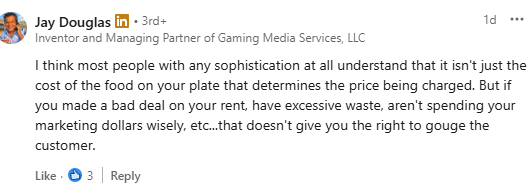
He is right. And I agree with him completely.
A restaurant that makes poor decisions and then passes all those costs onto the customer is not being fair.
A good operator manages waste tightly. Negotiates rent carefully before signing. Spends marketing money wisely. Trains staff to reduce errors.
I have worked hard to do all of those things. The price on my menu is not built from carelessness. It is built from careful daily management of every cost.
If I am charging $12 for a plate of Moroccan steak in continental food, it is because I know exactly what went into that plate. The meat yield. The masala cost. The gas used. The time my cook spent. The portion of rent for that table. That is not overcharging. That is honest costing.
Why Small Local Restaurants Deserve Your Support
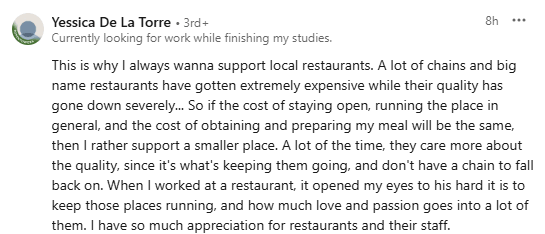
Yessica wrote something that genuinely moved me.
“This is why I always wanna support local restaurants. A lot of chains and big name restaurants have gotten extremely expensive while their quality has gone down severely… So if the cost of staying open, running the place in general, and the cost of obtaining and preparing my meal will be the same, then I rather support a smaller place. A lot of the time, they care more about the quality, since it’s what’s keeping them going, and don’t have a chain to fall back on. When I worked at a restaurant, it opened my eyes to his hard it is to keep those places running, and how much love and passion goes into a lot of them. I have so much appreciation for restaurants and their staff. “
Yessica
She is right. When you eat at a small home style kitchen, the person who cooked your food probably also planned the menu, ordered the ingredients, trained the helper, and will clean the kitchen tonight.
There is no head office sending down a frozen product to reheat. There is a real cook making real food every day.
That effort has value. And the price on the menu reflects it.
What Young Chefs Need To Learn Earlier
When I was younger, I thought cooking skills alone made someone a great chef.
Now I know better.
A real chef also understands:
- food cost percentage
- menu engineering
- kitchen overhead
- supplier negotiation
- inventory tracking
- labour management
Cooking beautiful food means little if the kitchen loses money on every plate.
That reality changes chefs over time.
How I Calculate a Menu Price
I want to show you how this works because most customers never see this side.
I will use a simple example.
Say I am making a plate of chicken karahi. Here is a rough breakdown of what goes into costing it:
- Raw chicken cost after yield: I buy whole chicken. After cleaning and portioning, I lose about 25 to 30 percent of the weight. So my cost per usable kilogram is higher than the purchase price.
- Masala and oil: Tomatoes, ginger, garlic, spices, cooking oil. All measured per portion.
- Gas and utilities: A small amount per plate based on monthly usage divided by total plates.
- Labour: My cook’s daily wage divided by how many plates he helps produce in a day.
- Overheads: Rent, insurance, licences. Divided across all plates for the month.
Add all of that up. Then I apply my target food cost percentage of around 30 to 35 percent.
That gives me a menu price that covers everything and leaves a small margin.
It is not a number I picked because it sounded good. It is a number I calculated carefully and then adjusted based on what the market accepts.
What I Want You to Take Away from This
I am not asking you to feel sorry for restaurant owners.
Most of us chose this Chef life. We love cooking. We love feeding people. But I do want you to understand what sits behind the price on a menu.
It is not greed. It is not laziness.
It is rent that runs every month. Staff who need to be paid. Fresh ingredients that sometimes do not make it to a plate. Utilities that never stop. Licences and taxes and insurance.
And it is years of learning how to balance all of that so the kitchen can stay open.
When you find a small restaurant that feeds you well, that treats you like a guest, that keeps its quality honest, please value it.
Those places are built on very thin margins and a lot of hard work.
If you ever want to understand a restaurant better, spend one week behind the scenes. See the early mornings. See the deliveries. Watch the waste that gets thrown away despite everyone’s best efforts.
Then look at the menu again. I think the price will feel different to you. Cook with care. Eat with gratitude. And support the small kitchens that are keeping real food alive.
